TikTok's branded content policy: when to disclose paid partnerships in ads. A #ad buried in hashtags isn't disclosure - it's an FTC fine waiting to happen.
Wait - TikTok Actually Enforces Branded Content Disclosure Now?
Oh yes.
Hard.
The era of chucking a #ad somewhere in the caption and hoping nobody notices is officially over.
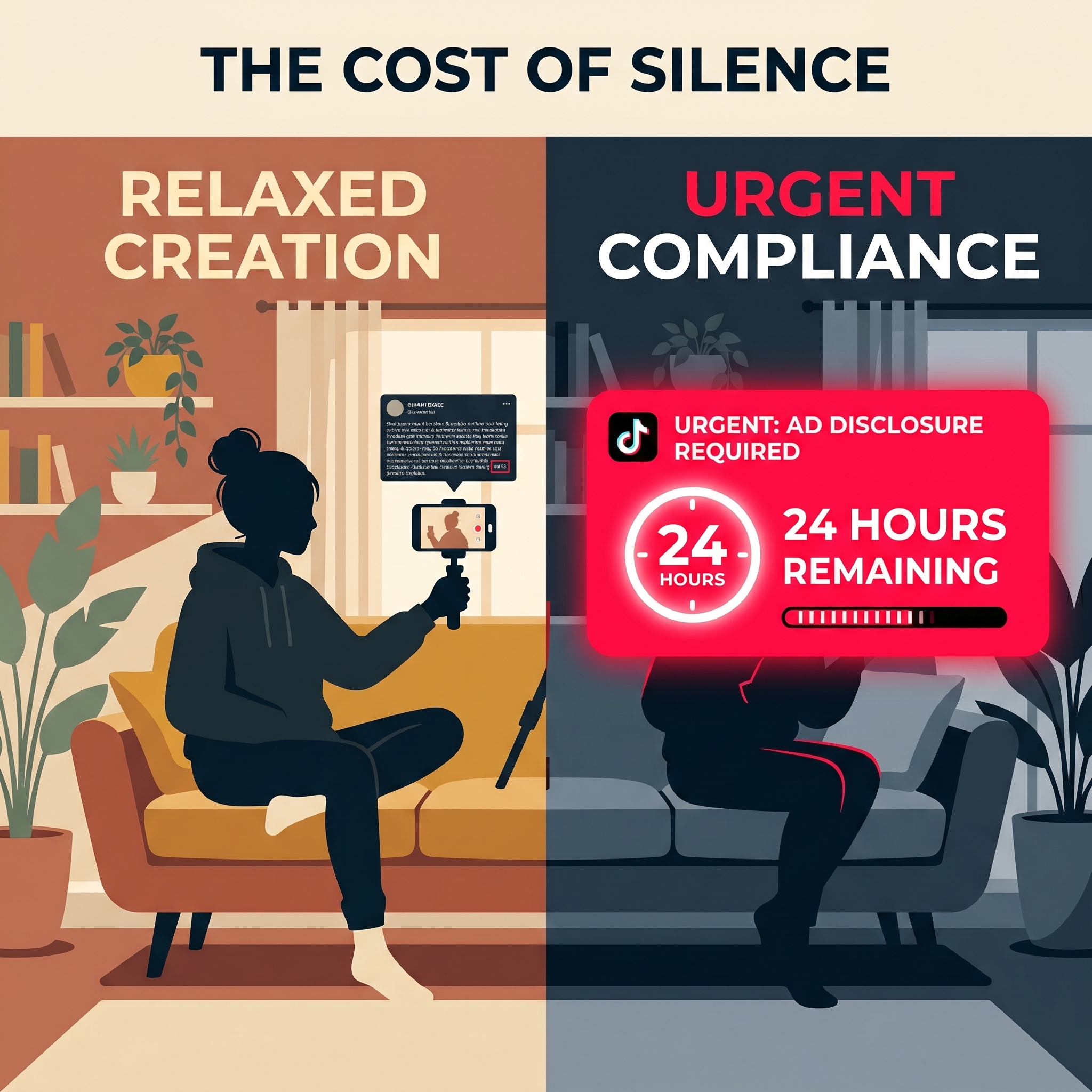
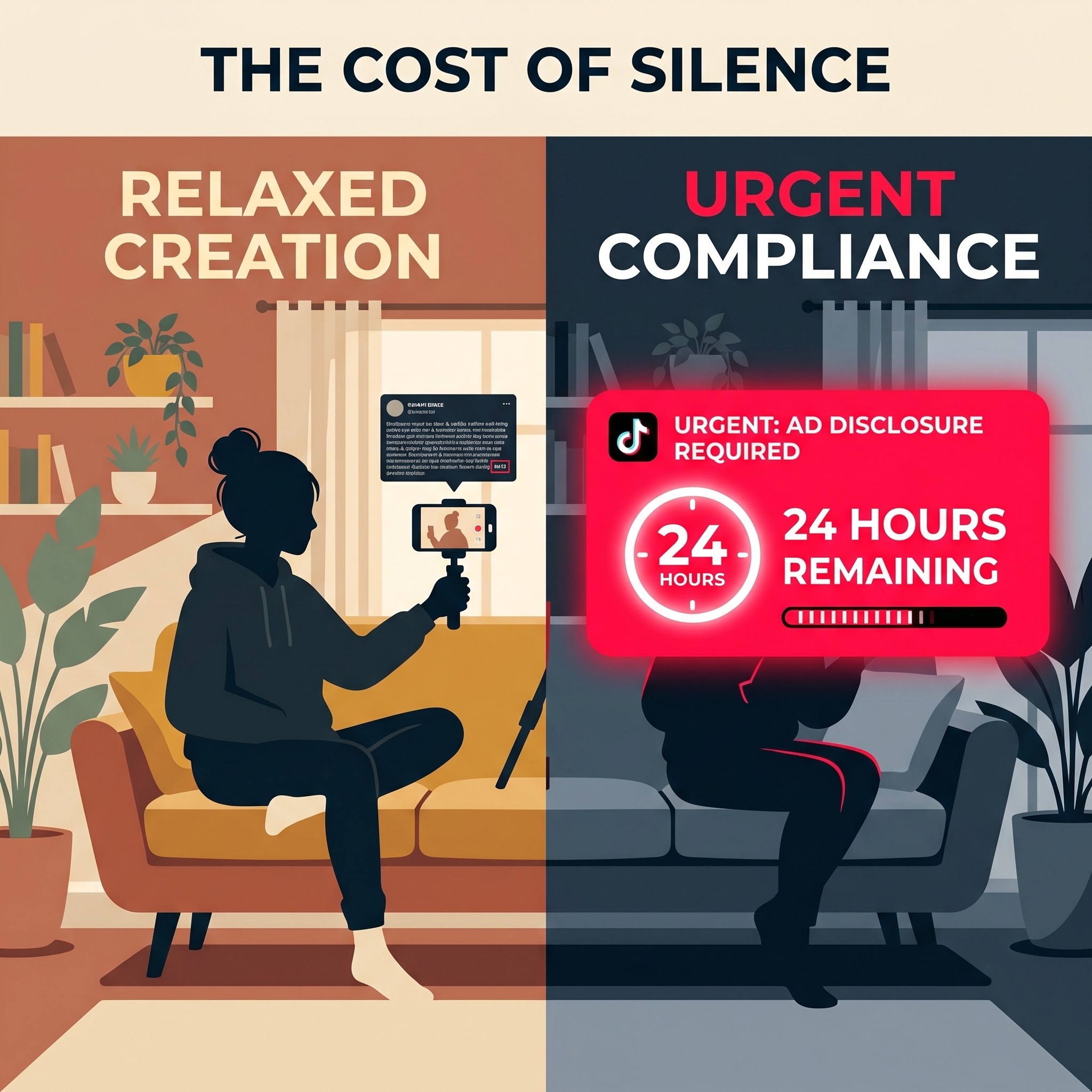
TikTok actively enforces its Branded Content Policy. Its system flags undisclosed commercial content and sends you an in-app notification, and you get a 24-hour window to correct it or appeal (TikTok's own help page spells it out). Miss that window and your video becomes ineligible for the For You feed. It still exists, your existing followers can still see it, but the algorithm-driven reach that makes TikTok worth using?
Gone.
And TikTok's enforcement is only layer one. In the US, the FTC's Endorsement Guides apply on top (TikTok's own advertiser help page says so), and outside the US, local advertising law applies too.
Both the creator and the brand can be on the hook. More on that shortly.
This is not a technicality.
This is one of the highest-risk compliance areas in the creator-brand ecosystem right now - and it catches brands and creators who thought they were across it.
Did TikTok Change Its Branded Content Policy in 2026? 📌
Updated 25 October 2026. Policy updates have been reported for 2026, but I could only confirm details on TikTok's own pages, so this section sticks to what TikTok's Branded Content Policy page actually says. The copy of that page I can load is dated November 2023. If TikTok has published a newer version, the live page is the one to trust.
Here's what it says, and it's worth knowing:
- Branded content is defined broadly. It's content that promotes a third party brand or its products or services in exchange for payment or any other incentive. The listed examples include gifted products, paid posts, commissions like affiliate links or promo codes, and brand ambassador relationships
- Several industries are listed as prohibited for branded content. Alcohol, financial services (with region-specific exceptions), gambling, over-the-counter and prescription medicines, and vitamin supplements that claim health benefits all appear on that list. Check it for your category before you sign a creator
- Country-specific restrictions can apply. TikTok may stop content being seen in some countries or apply other limits, such as age restrictions. TikTok's country-specific requirements page lists them
- Older posts aren't automatically safe. The policy says TikTok may need to apply updated rules to content you've already posted
Finance has its own ad rules on top, which the finfluencer breakdown covers. The disclosure rules in the rest of this post apply either way.
What Exactly Counts as "Branded Content" Under TikTok's Policy?
Branded content on TikTok means any video you post in exchange for something of value - cash, a free product, an affiliate commission, or an ongoing brand relationship - that promotes a third party's brand, product, or service. If money, product, or a business relationship changes hands, TikTok requires you to disclose it.
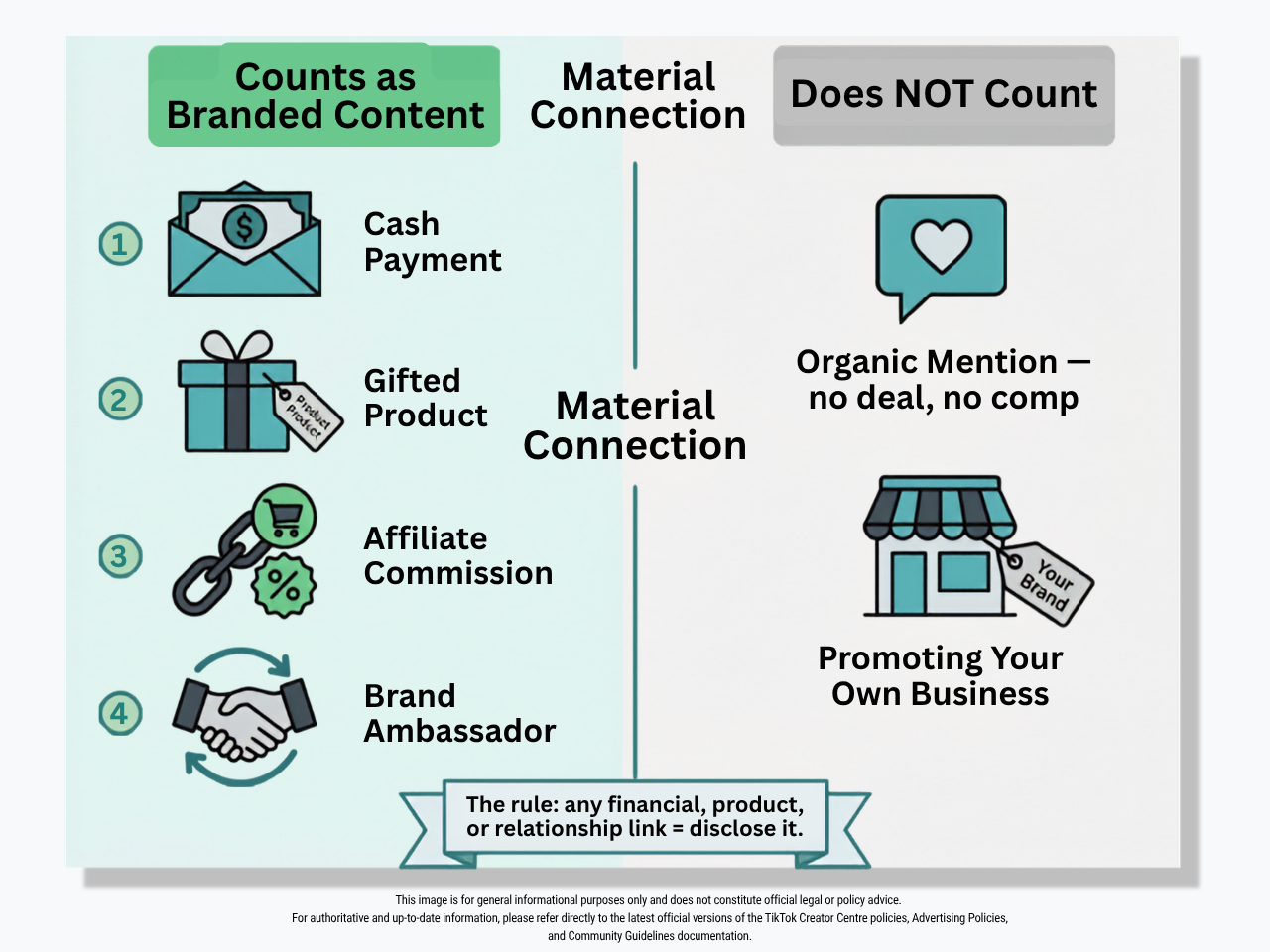
Broader than most creators assume. TikTok defines Branded Content as any content uploaded to TikTok in exchange for something of value, that promotes a third party's brand, product, or service. The definition covers:
- Cash payment - you're paid directly to feature a product or brand
- Gifted product - you received something for free in exchange for posting about it, even informally with no signed contract
- Affiliate arrangements - you earn commission from sales your post generates
- Brand ambassador relationships - an ongoing brand relationship, even when individual posts aren't directly paid
What doesn't count as branded content:
- Genuinely organic mentions of a brand you use with no compensation or commercial relationship whatsoever
- Promoting your own brand, product, or service - this needs disclosure too, but under the "Commercial Content" label rather than "Paid Partnership"
The core principle: material connection. Any financial, product-based, or relationship-based link between you and the brand you're featuring needs to be disclosed. Period.
"Paid Partnership" vs "Commercial Content" - What Is the Difference?
TikTok's disclosure system generates two different labels depending on your commercial situation:
| Label | When It Appears | What It Tells Viewers |
|---|---|---|
| "Paid Partnership" | Promoting a third party's brand, product, or service for compensation | Creator-brand commercial relationship disclosed |
| "Commercial Content" | Promoting your own brand, business, or product | Self-promotional commercial content |
TikTok adds the label to your video once you post it. TikTok's help page calls the two options Paid partnership and Commercial content, though some versions of the app have labelled the second one Promotional content.
How Do You Turn On the Disclosure Toggle?
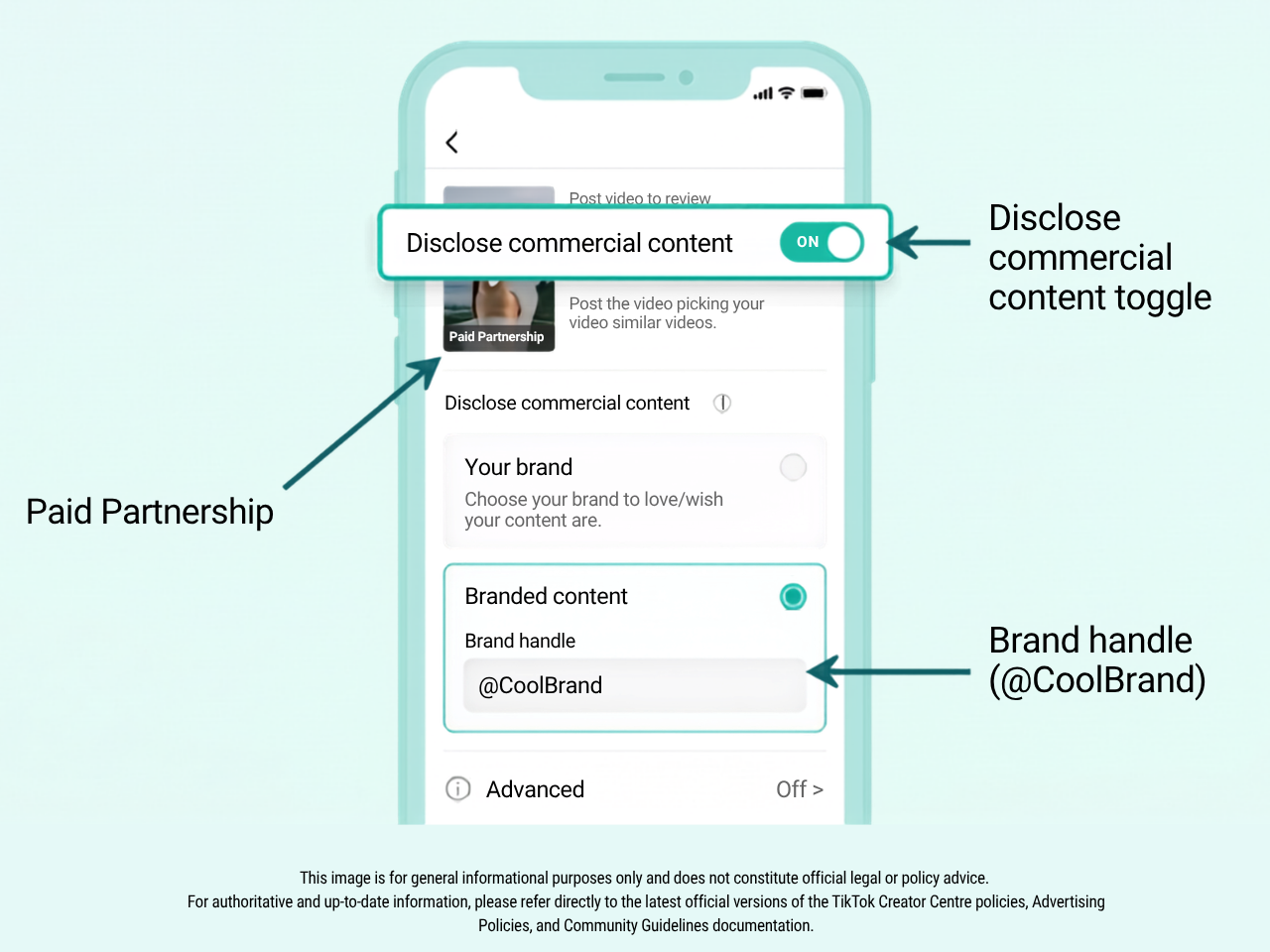
Five steps. Less than a minute. No excuse for skipping it:
- Create or upload your video in the TikTok app
- On the Post screen, tap "More options"
- Select "Disclose commercial content" - toggle ON
- Choose your label: "Your brand" → "Commercial Content" | "Branded content" → "Paid Partnership"
- If Branded Content: enter the brand's TikTok handle to notify them and give them access to post insights
- Post! 📧
That's it. 24-hour enforcement clock avoided 😉
What Does the FTC Require on Top of TikTok's Rules? (US)

This is where a lot of creators think they're covered when they're not.
TikTok's toggle is necessary. But it's not always sufficient for full FTC compliance on its own.
TikTok's own advertiser help page notes that the FTC's Endorsement Guides apply in the US. The FTC expects disclosures to be clear, conspicuous, and genuinely unavoidable - meaning something a viewer would actually encounter and process, not just a platform-generated label that flicks past.
What US regulators generally expect on TikTok (general guidance, not legal advice):
- #ad or #sponsored in the first line of your caption - not buried after 15 hashtags at the bottom
- Verbal disclosure in the video itself, early - "This is a paid partnership with [Brand Name]" within the first few seconds
- Do not rely on the TikTok platform label alone - regulators have indicated that platform labels by themselves may be insufficient in some contexts
What's at stake if you skip it:
| Violation Type | Potential Consequence |
|---|---|
| Undisclosed post | In-app notice, 24 hours to fix or appeal, then ineligible for the For You feed (TikTok) |
| Successful appeal | For You eligibility restored (TikTok) |
| Legal exposure | FTC Endorsement Guides apply in the US; rules vary by country |
| Brand / agency liability | Creator AND brand can both be on the hook, so get advice for your market |
📊 TikTok Ads Help: Commercial Content Disclosure setting for advertisers
Outside the US: Local Law Sits on Top of TikTok's Toggle
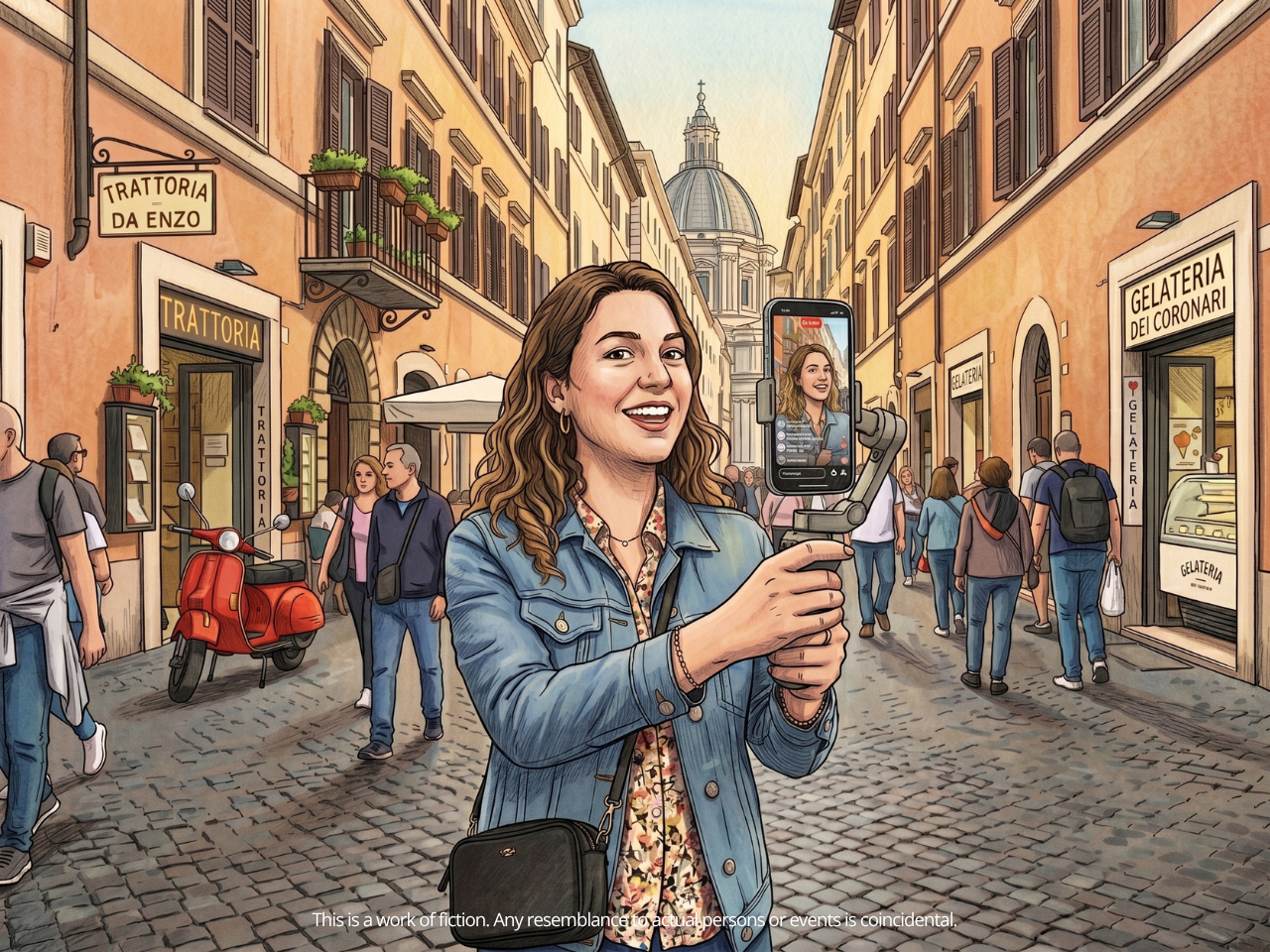
TikTok's own help page says exact legal requirements vary by country, and its country-specific requirements page shows how much TikTok itself changes by market. On top of that, your market may have advertising and consumer-protection rules of its own (the EU, UK and Germany are the usual examples), and those apply whether or not TikTok's toggle is on.
I'm not going to quote chapter and verse here, because the rules differ by country and change often. The practical takeaways are the same everywhere:
- TikTok's Branded Content toggle is the minimum requirement, your starting point, not your finish line
- Put a clear disclosure in the first line of the caption, because a platform label alone may not cover you under local advertising law
- Check the rules for every market you run in, and get local legal advice for anything high-value
If you're a creator in Germany, France, the Netherlands, or anywhere else operating in the branded content space - the toggle is habit, the #ad is in the first line of the caption, and you've checked your local rules.
What Happens If You Don't Disclose? The Exact TikTok Enforcement Sequence.
Here's how TikTok's own enforcement plays out step by step, per its help page:
- You post commercial content without enabling the disclosure toggle
- TikTok's detection system flags the post
- You receive an in-app notification of the potential violation
- A 24-hour correction window opens to fix it or appeal
- Corrected within 24 hours: video continues normally, no further action taken
- Not corrected within 24 hours: the video becomes ineligible for the For You feed, so reach to new audiences takes a hit
- Repeated non-disclosure: TikTok doesn't publish a ladder for this, but expect it to count against your account under its wider enforcement rules
The 24-hour window sounds generous.
It isn't - if you're asleep, travelling, or not checking notifications, it closes faster than you think.
Spark Ads and Branded Content: The Part Nobody Explains Clearly
This is where brands and agencies consistently get caught - because Spark Ads introduce a compliance scenario that TikTok's own documentation doesn't make particularly obvious.
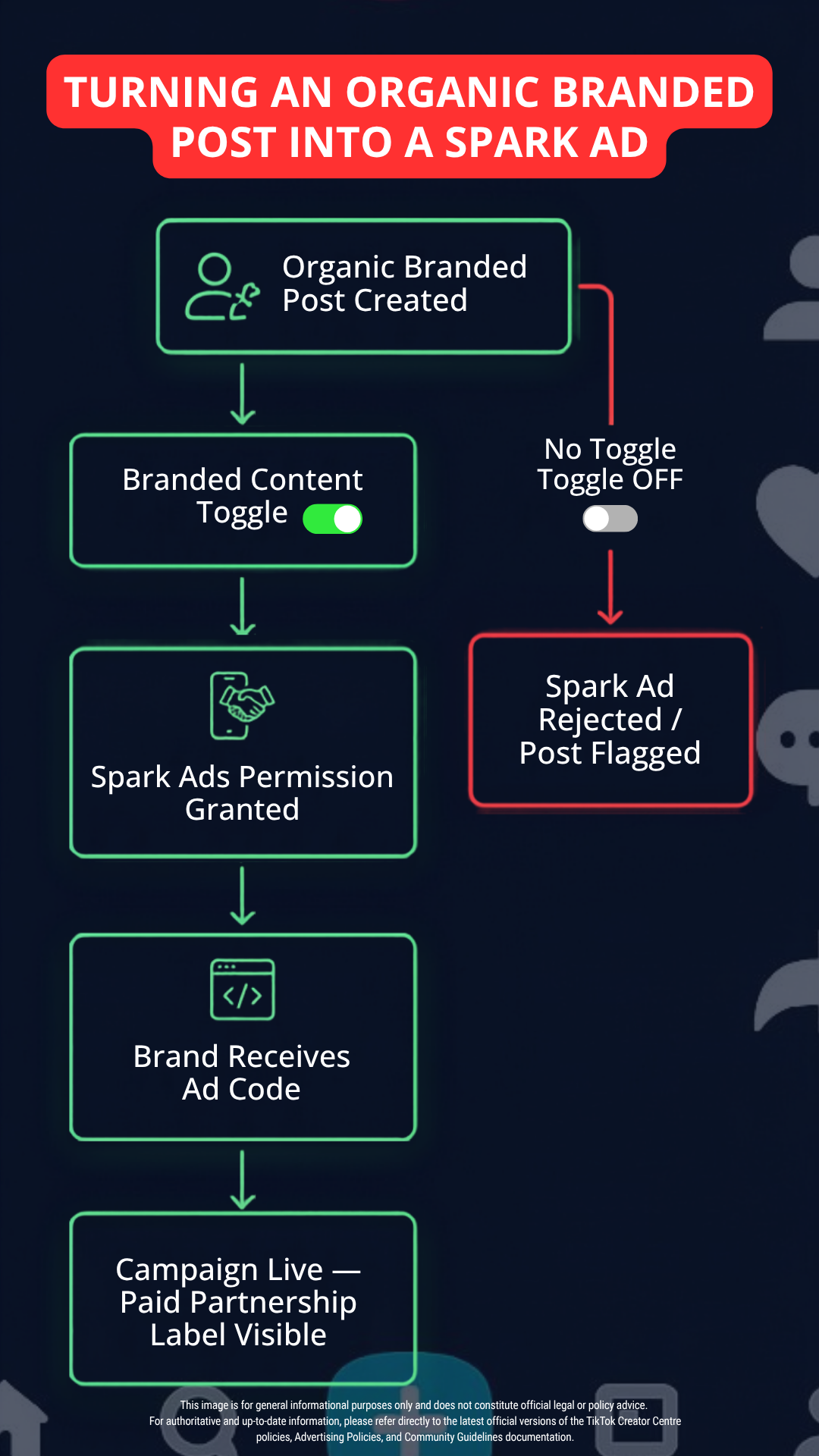
Spark Ads allow you to boost an existing organic TikTok post as a paid ad. When that organic post is branded content - made in exchange for compensation - the disclosure requirements apply to the original organic post, and must be in place before any boosting happens.
What's actually required:
- The original organic post must have the Branded Content toggle enabled before boosting begins
- The creator grants the brand Spark Ads permission via: Settings → Creator Tools → Spark Ads
- The brand receives a Spark Ads code from the creator and links it to the campaign in Ads Manager
- The "Paid Partnership" label must be visible and active both before and throughout the campaign run
What happens if you boost without the disclosure: The Spark Ad can be rejected. The brand account can be flagged. TikTok can retroactively flag the organic post - triggering the 24-hour correction window even for a post that's already been live.
For Agencies: Stop Treating Disclosure as the Creator's Problem
Here's the real talk.
If you're running influencer campaigns and disclosure isn't baked into the brief, the contract, and the payment process - you are creating liability for your client and for yourself simultaneously. In many markets, that liability is legal, not just platform-level.
Build it in from day one:
- Brief stage: Disclosure requirements are a deliverable, not a suggestion
- Contract stage: Branded Content toggle activation is a contractual obligation before payment is released
- Pre-campaign: Spark Ads permission and code required before campaign launch - not after
- Live campaign: Verify the "Paid Partnership" label is visible on the organic post before boosting begins
One missing toggle on one post can pull a campaign's peak launch-week momentum at exactly the moment it matters most.
Does Putting "Paid Partnership" on Your Post Kill Reach?
Short answer: no. TikTok says it has the data to prove it.
TikTok's own help page cites an internal study that found no performance difference between videos with proper branded content disclosure and videos without.
The fear that disclosure kills reach is not supported by TikTok's own platform data. What drives performance is the quality and authenticity of the creative. A "Paid Partnership" label on content that genuinely resonates does not make audiences scroll away.
In 2026, audiences are increasingly savvy about creator-brand relationships. Transparent disclosure on strong content builds credibility. Hidden commercial content that gets detected later erodes it - fast.
📊 Source: TikTok Ads Help: Commercial Content Disclosure setting for advertisers
Common Scenarios That Lead to a Violation
🧐 Scenario 1 - The gifted-product post with no toggle. A skincare brand sends a PR package with a note asking you to "share your honest thoughts if you love it." No contract, no fee. You post a glowing review without enabling the disclosure toggle. Gifted product with an expectation of coverage = branded content. No toggle = violation on TikTok, and likely under your local advertising rules too.
🧐 Scenario 2 - The caption disclosure that doesn't count. You write "gifted by @brand 🎁" in the middle of your caption. US regulators expect disclosure up front, and European regulators expect it to be visible without extra clicks. Mid-caption placement is a bad bet under either.
🧐 Scenario 3 - The Spark Ad boosted from an undisclosed organic post. A brand pays to boost your post about their product. Your original post didn't have the disclosure toggle active. The Spark Ad submission is rejected, the organic post gets flagged, and the brand's campaign is delayed during a time-sensitive launch window.
🧐 Scenario 4 - The affiliate commission arrangement. You're promoting a service using an affiliate link - earning commission on sign-ups, no flat fee. You treat it as organic content because you're not paid upfront. Commissions like affiliate links and promo codes are explicitly within TikTok's definition of branded content, so the toggle still applies. Advertising rules in many markets treat a commission as an incentive too, whatever the platform.
Compliance Checklists
For Creators:
◻ "Disclose commercial content" toggle activated before posting
◻ Correct label selected - "Your brand" or "Branded content"
◻ Brand handle entered correctly for third-party promotions
◻ #ad or #sponsored in the first line of caption (the safest placement under US and EU rules)
◻ Verbal disclosure included early in the video itself
For Brands and Agencies:
◻ Disclosure requirement written into the creator brief and contract
◻ Creator confirmation of toggle activation received before the post goes live
◻ Spark Ads permission granted and code received before campaign launch
◻ Post verified for "Paid Partnership" label before boosting begins
◻ Disclosure confirmation tied as a milestone to creator payment approval
◻ Local advertising rules reviewed for every market you target - brand liability is separate from creator liability
◻ Product category checked against the prohibited industries list in TikTok's Branded Content Policy
For Spark Ads Specifically:
◻ Original organic post has Branded Content toggle enabled
◻ Spark Ads code obtained from creator
◻ "Paid Partnership" label visible on the organic post
◻ Spark Ad submitted through Ads Manager with creator's code linked
Frequently Asked Questions
Does TikTok require creators to disclose paid partnerships?
Yes. TikTok's system flags undisclosed commercial content and sends an in-app notification. Creators get 24 hours to add the disclosure or appeal before the video becomes ineligible for the For You feed.
Did TikTok change its Branded Content Policy in 2026?
I can only confirm what TikTok publishes. The Branded Content Policy page I can load is dated November 2023. It lists alcohol, financial services, gambling, medicines and health-claiming vitamin supplements as prohibited industries for branded content, with country-specific restrictions on top. If TikTok has published a newer version, the live policy page is the one to trust.
What counts as branded content on TikTok?
Any content posted in exchange for something of value that promotes a third party's brand, product, or service - cash payment, gifted product, affiliate commission, or an ongoing brand ambassador relationship all count, even without a signed contract.
Does disclosing a paid partnership hurt your TikTok reach?
No. TikTok says an internal study found no performance difference between videos with and without proper disclosure. Undisclosed commercial content, on the other hand, can become ineligible for the For You feed.
Is TikTok's disclosure toggle enough to meet FTC requirements?
Not on its own. The FTC also requires #ad or #sponsored in the first line of your caption and a verbal disclosure early in the video - relying on TikTok's platform label alone may not satisfy FTC rules. THIS IS IMPORTANT!
What happens if you don't disclose a Spark Ad boost?
The disclosure requirement applies to the original organic post before any boosting happens. If it wasn't disclosed, the Spark Ad can be rejected and the organic post itself can be retroactively flagged.
Are EU creators held to stricter disclosure rules than TikTok's own policy?
Often, yes. Outside the US, local advertising and consumer-protection rules apply on top of TikTok's toggle, and TikTok's own help page says legal requirements vary by country. Check the rules for every market you run in.
Where can I check if my TikTok ad script or caption is compliant before I post it?
Paste your ad script, caption, or landing page copy into the free TikTok ad compliance checker for an instant compliance score, flagged risk areas, and the exact fix - no signup required.
Do TikTok ad creatives need to meet different requirements than organic branded content?
The same disclosure rules apply to both, but paid ads add an extra layer: the creative itself also has to meet TikTok's 2026 ad specs for resolution, aspect ratio, and file format. Grab the free one-page specs cheat sheet to check both at once before you launch.
Disclosure toggle sorted?
A few more things worth checking before you hit publish: whether your creative actually meets the 2026 spec sheet for resolution, aspect ratio and file format (grab the free one-page cheat sheet if that's faster), whether any AI-touched footage needs the AIGC disclosure toggle as well, and if you are running this across a team, the 5-gate pre-upload workflow is worth setting up so this stops being a one-off check. Want a fast gut-check before you go live? Run it through the free TikTok ad compliance checker for an instant score and flagged issues.
Last reviewed: 25 October 2026. Every link in this post points to TikTok's own pages or to other posts on this site.
This article reflects TikTok's official policy guidelines as published at the time of writing. TikTok updates its policies regularly, so always refer to the TikTok Advertising Policies page for the latest information. First Review accepts no liability for changes made after publication.


