

Copyright and music licensing in TikTok ads. The trending sound that made your organic post blow up could be the exact thing tanking your paid campaign.
The Music Trap That's Catching Thousands of TikTok Advertisers

Here's a scenario that plays out every single day, and it's probably more common in your world than you'd expect:
You find an absolute banger of a trending sound. It fits the vibe of your creative perfectly, it's been blowing up organically, and you've used it in a few posts that are doing great. So naturally, you decide to put some ad spend behind it.
Rejected. Audio licensing violation.
Wait - what? You didn't steal anything. It was right there in TikTok's own sound library.
What's the problem?
Here's the thing: TikTok's standard sound library is licensed under agreements with music labels and publishers for personal, non-commercial use only. The second you're running paid promotion, you're making a commercial use of that audio - and that requires an entirely different licence. The sounds that are completely fine for your organic TikTok? Not automatically fine for your ads.
Full stop.
This is probably the single most misunderstood rule in TikTok advertising. And it doesn't just catch solo creators - it catches agencies, brands, and entire marketing teams who've been running paid campaigns for months without realising they've been in violation the whole time.
What Is TikTok's Commercial Music Library - and How Do You Actually Use It?

The Commercial Music Library (CML) is TikTok's dedicated catalogue of pre-licensed audio specifically cleared for paid ad campaigns. Hundreds of thousands of tracks, every genre and mood imaginable, zero licensing risk. Use it and you're covered.
How to Find the Commercial Music Library (CML) on TikTok?
This trips people up constantly. The CML is only accessible through TikTok Ads Manager - not the TikTok app you use every day. If you're browsing sounds inside the app, those are organic sounds, and they can't go in your ads.
Here's the path:
1. Log in to ads.tiktok.com
2. Go to Creative → Creative Assets → Music
3. Filter by Genre, Mood, Duration, or BPM
4. Preview tracks directly in the browser
5. Save to your campaign asset library - done
One thing to watch: some tracks in the CML have territory restrictions.
If your campaign is running across multiple markets, always verify the track is cleared in all of them before building your creative around it. Finding out at submission that your chosen track isn't available in three of your five target markets is not a fun situation.
Organic Sounds vs. Commercial Music Library: The Full Breakdown
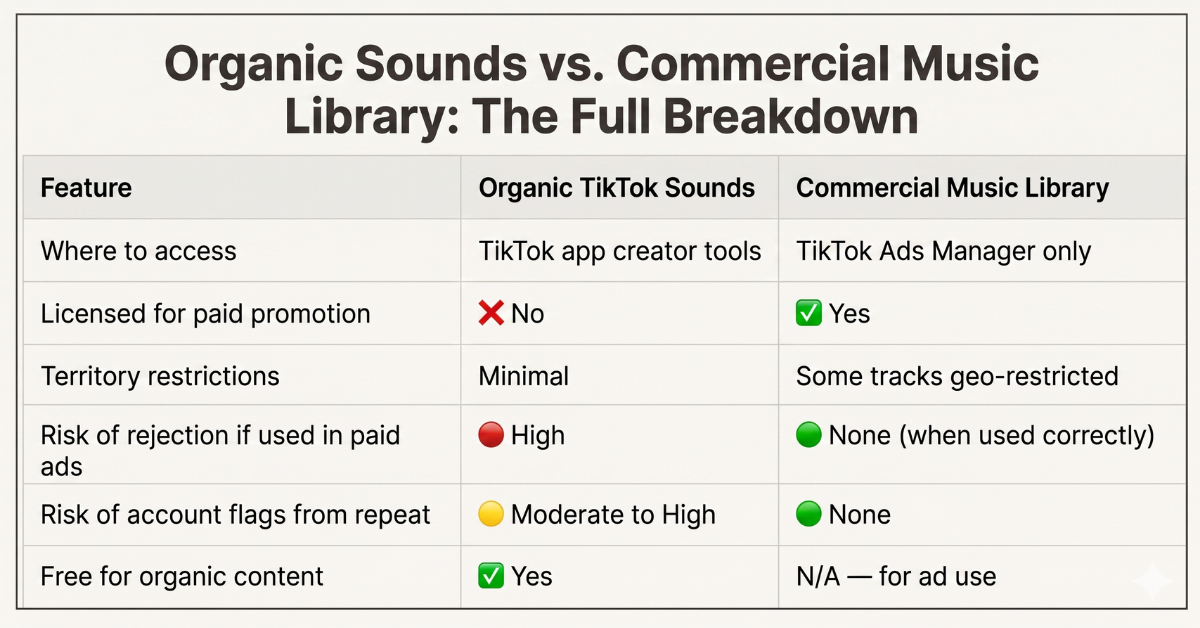
The most important column in that table? The rejection risk row.
The most-used trending sounds are among the highest-risk audio assets for advertisers - because their popularity is almost entirely built on organic licensing that doesn't extend to paid promotion.
Can You Use Your Own Music or AI Audio? (Yes - Here's How)
Absolutely, and for a lot of creators and brands, original audio is actually the best option.
It eliminates all third-party licensing risk and makes your brand sound more distinctive. A custom sound that becomes associated with your brand is a genuine competitive advantage.
What Counts as Compliant Original Audio
- Voiceovers recorded by you, your team, or a professional VO artist
- Original compositions made specifically for the campaign
- AI-generated music - with important caveats (see below)
- Royalty-free licensed music from third-party platforms - when the licence explicitly covers paid advertising
Third-Party Royalty-Free: Don't Assume, Verify
Platforms like Epidemic Sound, Artlist, Musicbed, and Soundstripe are solid options - but "royalty-free" does not automatically mean "TikTok ad safe." Before building any campaign around a third-party track, verify your licence covers:
☐ Paid social media advertising (not just personal or editorial use)
☐ Commercial promotion specifically
☐ All territories where your ads will run
☐ Any attribution requirements in the licence terms
A lot of mid-tier royalty-free platforms have personal licences that sound broad but quietly exclude paid advertising campaigns. Always read the tier details.
☝️ Thirty seconds of verification saves 24 hours of rejection headaches.
AI Music Tools for TikTok Ads
AI music generation has genuinely become useful for creators. But this corner of the market has changed a lot since this post first went live (updated 20 October 2026), and commercial rights still vary by plan and platform. Here's where the big names stand right now:
• Soundraw: Business plans include commercial advertising licensing ✅ (check the current plan terms before you build a campaign around it)
• Suno and Udio: Both have been reworking their models and their licensing deals with the major labels, and what you can download or export has been changing by plan. If you can't export the file, you can't upload it to Ads Manager, and even an exported track doesn't help if the plan's licence doesn't cover paid advertising. Read each tool's current terms on the day you use it, not the day you bookmarked it
Does Getting an Audio Violation Actually Cause a TikTok Shadowban?

This question comes up constantly in creator communities, and there's a lot of noise around it. Let's cut through it.
TikTok doesn't officially use the term "shadowban." But in the advertising context, the effects of accumulated violations are very real - and audio violations are one of the documented pathways to them.
What an ad account shadowban actually looks like in practice:
🛑 Ads stuck in "In Review" indefinitely with no resolution
🛑 Significantly reduced delivery despite healthy budgets and competitive bids
🛑 Higher rejection rates on new creatives that should sail through review
🛑 Account health warnings appearing in your Ads Manager dashboard
🛑 Mysteriously elevated CPMs with a corresponding drop in reach
Here's the escalation path that leads there:
• First audio violation: Ad rejected, reason code assigned, no account action
• Second violation: Ad rejected, manual review flag placed on the account
• Third+ violation: All future submissions face elevated scrutiny - longer queues, more rejections on compliant content
• Systematic violations: Account spending restriction or full suspension
• TikTok's review system has memory. Your account's compliance history shapes how future creatives are treated - whether TikTok ever communicates that to you or not.
TikTok doesn't publish an official strike ladder like this one, so read it as the typical pattern and not a guarantee.
Spark Ads and Boosted Content: The Sneakiest Audio Risk of All
Spark Ads - where you boost an existing organic post as a paid ad - is where the most avoidable audio mistakes happen. And they happen because the organic post was already performing well, so everyone assumes the content is fine.
Here's the exact sequence that causes the problem:
1. Creator posts organic content with a trending sound ✅ compliant for organic
2. Brand decides to boost that post as a Spark Ad
3. The boosted version is now paid promotion - commercial licensing rules apply
4. The trending sound is not in the CML
5. TikTok rejects the Spark Ad for audio violations and flags the account 🚩
The original organic post was fine because it was fine - for organic.
The problem only surfaces when paid amplification is applied. By that point, you've already built your entire campaign launch around a track that can't legally be used in it.
How to Check Before You Boost
Before activating any Spark Ad boost:
☝️ Identify the audio track used in the original post
☝️ Search the CML in Ads Manager for that specific track
☝️If it's in the CML: You're clear to boost
☝️If it's NOT in the CML: Re-edit the original post with a CML alternative first
Let the re-edited post run for 24–48 hours before activating the Spark Ad boost.
What to Do If Your Ad Is Already Rejected for Music Violations
Step-by-step recovery:
1. Check the rejection reason code in Ads Manager for audio-specific notes
2. Do not appeal without changing the content - appeals for music licensing violations almost never succeed without first removing the infringing audio
3. Remove the track from the creative entirely
4. Replace with a CML alternative - match the original mood, tempo, and energy as closely as you can
5. Re-export the video with the new audio embedded
6. Resubmit as a revised creative
If you have documented commercial licensing for the flagged track, you can submit that documentation via TikTok's business support channel.
⚠️ Fair warning: this process is manual, slow, and inconsistently handled across different support agents.
Prevention beats appeals - every single time.
Audio Compliance Checklist for TikTok Ads (Screenshot This)
Before uploading any creative with audio:
Source Verification:
☐ Audio is from TikTok's Commercial Music Library, OR
☐ Audio is 100% original with no third-party IP, OR
☐ Audio is royalty-free with a licence explicitly covering paid social media advertising
☐ Audio is AI-generated, you can download the actual file, and your plan's current terms cover commercial advertising
CML Track Check:
☐ Track is available in all target territories
☐ Duration fits the ad without awkward looping
☐ Volume levels are balanced - not clipping, not too quiet relative to voiceover
Spark Ad Specific:
☐ Original organic post audio verified against the CML
☐ If not in CML: post re-edited with compliant audio before boosting
☐ Re-edited post has been live 24+ hours before Spark Ad activation
Third-Party Licensed Audio:
☐ Licence explicitly covers paid social media advertising
☐ All territories covered
☐ Attribution requirements reviewed and noted if applicable
Frequently Asked Questions
Can I use TikTok's trending sounds in paid ads?
No, not by default. TikTok's standard sound library is licensed for personal, non-commercial use only. The moment you put paid spend behind a video, you need audio from the Commercial Music Library or another properly licensed source instead.
Where do you find music that's cleared for TikTok ads?
TikTok's Commercial Music Library (CML), accessible only through Ads Manager under Creative → Creative Assets → Music - not inside the regular TikTok app. Every track there is pre-licensed for paid campaigns, though some carry territory restrictions worth checking first.
Can you use AI-generated music in TikTok ads?
Yes, but commercial rights vary by plan and platform, and the market is moving fast. Soundraw includes commercial advertising licensing on business plans. Suno and Udio have both been changing their models, label deals and download rules, so check each tool's current terms before you use any AI track in a paid campaign. If you can't export the file, or the plan's licence doesn't cover paid advertising, it can't go in your ad.
Does an audio licensing violation cause a TikTok shadowban?
TikTok doesn't use the term officially, but repeated violations produce the same effect: ads stuck in review, reduced delivery, higher rejection rates, and account health warnings. The escalation path runs from a simple rejection on the first violation to spending restrictions or suspension after systematic ones.
Do Spark Ads need separate music licensing from organic posts?
Yes. An organic post with a trending sound is fully compliant until you boost it as a Spark Ad, at which point it becomes paid promotion and commercial licensing rules apply. Always check the original track against the CML before activating the boost.
Last reviewed: 25 October 2026. Every link in this post points to TikTok's own pages or to other posts on this site.
This article reflects TikTok's official policy guidelines as published at the time of writing. TikTok updates its policies regularly, so always refer to the TikTok Advertising Policies page for the latest information. First Review accepts no liability for changes made after publication.


